Introduction The Realities Behind Modular Nuclear Economics
The nuclear industry presents small modular reactors, or SMRs, as a way to escape the financial traps that have defined many large nuclear projects. Smaller units should require less capital per decision, shorter construction periods, and lower exposure to the megaproject overruns that have damaged investor confidence. The stronger proposition is not simply that an SMR is smaller, but that a repeatable reactor can be manufactured in a controlled industrial environment rather than assembled almost entirely at a site.
That promise remains strategically important as power demand rises from data centers, industrial electrification, hydrogen production, and broader economic growth. Yet as late 2026 approaches, commercial evidence still points to a persistent capital hurdle rather than an immediate economic breakthrough. NuScale”s US460 design, approved by the US Nuclear Regulatory Commission for a 462-megawatt plant using six 77-megawatt modules, represents meaningful regulatory progress, but approval does not equal a construction permit, a binding customer order, or project finance.
SMR economics therefore require a disciplined separation between manufacturing theory and field construction realities. Factory repetition can improve reactor-module costs, but the plant still needs a site, foundations, containment, cooling systems, grid interconnection, security, licensing, qualified suppliers, and a financing structure capable of carrying risk for years. The commercial question is not whether modularity has value. It is whether that value is large and bankable enough to offset the costs that modularity cannot remove.
Section 1 Standardized Factory Floor Ambitions Versus Bespoke Regulatory Realities
The primary financial thesis behind SMRs is a learning curve. A manufacturer that produces the same reactor pressure vessel, steam systems, control equipment, and module interfaces repeatedly should gain productivity, reduce rework, improve quality assurance, and spread engineering costs across a larger fleet. This model resembles aircraft or heavy industrial manufacturing more than conventional nuclear construction. The first units may be expensive, but later units could benefit from standardized tooling, trained labor, established supplier relationships, and predictable installation procedures.
The difficulty is that reactor standardization is never determined by the factory alone. Nuclear licensing remains sovereign, and national regulators apply distinct requirements covering seismic design, emergency planning, containment, cybersecurity, quality assurance, operator training, environmental review, and safeguards. A design that is standard in one market may require changes to safety analysis, equipment qualification, instrumentation, or site layout in another. Such changes can interrupt production sequences, reduce component commonality, and force manufacturers to maintain multiple design variants.
The NRC”s approval of NuScale”s US460 design is an important procedural milestone because the approved design can be referenced in future construction permit, operating license, or combined license applications. However, NuScale or a project entity must still secure the necessary site-specific approvals, a process that can take at least 30 months. The distinction matters for investors: design certification lowers a category of licensing risk, but it does not eliminate project development risk, site risk, or customer risk. The NRC”s advanced reactor regulatory roadmap illustrates the level of technical scrutiny that standard designs must pass before construction can begin.
- Factory standardization reduces repetition costs only when equipment specifications remain stable.
- National licensing differences can create parallel engineering and documentation requirements.
- Site-specific reviews continue after a reference design receives regulatory approval.
- International coordination can improve information sharing without creating a single global license.
The International Atomic Energy Agency reported growing SMR interest in 2025, with more than 40 member states expressing interest and requesting support on technology, economics, legal frameworks, safety, security, and safeguards. Its harmonization initiatives can help countries build capability and reduce duplicated effort, but they do not remove national sovereignty over nuclear approvals. For developers, that means the addressable market may be global while the licensing platform remains fragmented. The resulting commercial model must balance the efficiency of one design against the cost of adapting it to several regulatory jurisdictions.
Section 2 Why Passive Safety Does Not Automatically Eliminate Civil Engineering Costs
Passive safety is one of the strongest technical arguments for advanced reactors. Systems that rely on gravity, natural circulation, pressure differentials, or stored energy can reduce dependence on powered pumps and active intervention during certain accident scenarios. That may simplify operating systems, reduce some equipment requirements, and strengthen the safety case. It does not, however, turn a nuclear plant into a compact appliance that can be installed without substantial civil works.
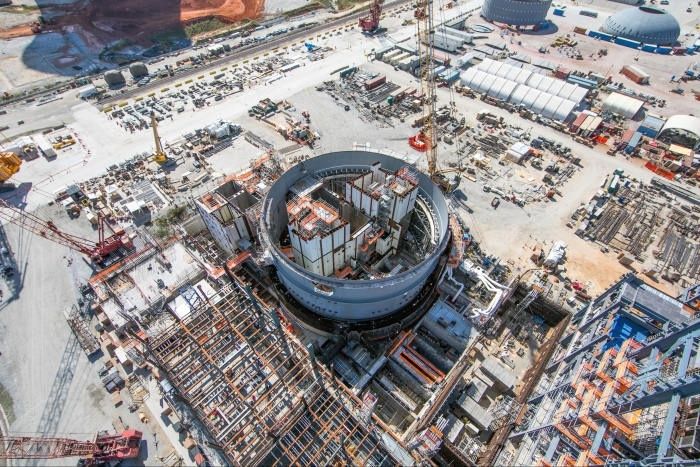
The balance of plant remains a large part of the investment. Site preparation, excavation, foundations, seismic qualification, containment, cooling infrastructure, electrical systems, control buildings, security, waste handling, and grid connection must be designed and constructed even when the reactor module arrives largely complete. Many of these costs are linked to site conditions and regulatory requirements rather than reactor output. A 77-megawatt module does not need one-sixth of the permitting, security, grid, or construction management effort required by a larger plant.
That creates an unfavorable per-megawatt effect when the unit is made smaller. A large reactor can spread common infrastructure across hundreds or more megawatts, while an SMR plant may need comparable categories of infrastructure for a lower total output. Multiple modules can improve operational flexibility and allow staged capacity additions, but they can also multiply interfaces, lifting equipment requirements, testing obligations, and coordination costs.
| Capital category | Why modularity helps | Why costs remain |
|---|---|---|
| Reactor modules | Factory production can improve repetition, quality control, and labor productivity. | First-of-a-kind engineering, specialized manufacturing, and nuclear-grade testing remain expensive. |
| Site and civil works | Repeatable layouts may simplify design and construction planning. | Excavation, foundations, seismic design, containment, and site conditions remain location-specific. |
| Balance of plant | Some systems can be shared across multiple modules. | Cooling, electrical, security, control, and waste systems still require substantial installation. |
| Grid connection | Smaller output may suit constrained grids or dedicated customers. | Interconnection studies, substations, transmission upgrades, and reliability requirements are not eliminated. |
Federal assessments of SMR economics also distinguish between the modular reactor island and the external balance of plant. The Department of Energy SMR assessment helps show why a lower-cost reactor module does not automatically produce a proportionately lower total project cost. This distinction is especially relevant for data centers and industrial customers, which may require dedicated transmission, backup capacity, water systems, or high reliability standards in addition to the nuclear facility itself.
Section 3 Supply Chain Vulnerabilities and the Specialist Component Bottleneck
Commercial deployment depends on more than reactor vendors and utilities. A reliable SMR pipeline requires heavy-forge capacity, nuclear-grade steel and specialized materials, module fabrication, qualified welding, certified valves and pumps, advanced instrumentation, fuel manufacturing, transportation, and experienced project controls. Advanced designs may also require supply capabilities that are not widely used across the existing light-water reactor fleet.
Fuel is a particularly important constraint for several advanced reactor concepts. High-assay low-enriched uranium, or HALEU, requires conversion, enrichment, deconversion, transport, and fabrication infrastructure. A reactor design may be technically ready while its fuel supply remains commercially immature. That creates a sequencing problem: suppliers hesitate to invest before firm reactor orders exist, while developers hesitate to commit before fuel availability and pricing are visible.
The EPRI advanced reactor supply-chain program identifies insufficient module fabrication capacity, shortages of nuclear-grade components, inadequate small-forging capability, specialized-material gaps, and the commercial immaturity of advanced manufacturing as material risks. Its proposed response includes capability mapping, supplier development, risk-sharing arrangements, revenue-sharing mechanisms, government support, proof-of-concept demonstrations, and secured offtake. These are not secondary industrial details. They determine whether an approved design can become a repeatable product.
- Large forgings and specialized fabrication capacity may become schedule bottlenecks.
- Suppliers need credible order books before committing capital to dedicated facilities.
- HALEU infrastructure must develop alongside reactor deployment, not years afterward.
- New manufacturing methods require qualification under nuclear codes and quality systems.
- Transportation and project integration must be planned for oversized or sensitive components.
Strategic partnerships can help close these gaps, but announced memoranda must be treated carefully. For example, cooperation frameworks involving fuel-cycle services, advanced manufacturing, licensing, and transportation can establish a path toward capability building, yet a non-binding memorandum does not guarantee funded work, a purchase order, or a commercial plant. Investors should distinguish between a partnership that improves technical readiness and one that creates enforceable demand. Without firm orders, the supply chain may remain too fragmented to justify the large upfront investments required for dedicated SMR logistics and fabrication.
Section 4 Investor Timelines and the Gap in Early Stage Risk Tolerance
SMRs expose a fundamental mismatch between infrastructure development and much of the private capital market. Venture funds and private equity vehicles often seek liquidity or substantial value realization within roughly seven years. Nuclear projects typically require years of design, licensing, site development, procurement, construction, commissioning, and performance validation before stable revenue begins. Even when a plant is technically successful, the capital may need to remain invested through a decade-long amortization period.
Interest rates intensify the problem. During development, the project may generate no electricity revenue while accumulating engineering, licensing, land, insurance, supplier reservation, and management costs. A higher discount rate reduces the present value of future power sales and increases the carrying cost of delayed construction. This makes the cost of capital a defining variable, not a background assumption. An SMR with a modestly lower overnight construction cost can still produce unattractive electricity economics if licensing or customer negotiations extend the development period.
NuScale”s US460 approval illustrates the difference between technical progress and investable cash flow. The approval was completed in less than two years and ahead of schedule and budget, but the company still needed a binding customer agreement and additional permits. A potential operational target around the end of 2030 would depend on a deal being finalized promptly, followed by successful project execution. Such conditional timelines are useful indicators of ambition, but they should not be treated as contracted revenue forecasts.
- Secure a credible anchor customer with a creditworthy offtake commitment.
- Separate design approval from site-specific licensing and construction authorization.
- Quantify financing exposure under schedule delays, interest-rate changes, and cost escalation.
- Establish supplier reservations without paying for capacity that lacks a bankable project.
- Use public support to reduce first-of-a-kind risk while preserving private accountability.
Public-private cost-share programs are therefore central to early deployment. Government grants, tax credits, loan guarantees, and national industrial strategies can absorb part of the technology and infrastructure risk. They cannot fully substitute for an offtaker willing to sign a long-term contract, provide credit support, or accept construction and commissioning uncertainty. Data centers may offer a promising customer segment because of their appetite for firm power, but their procurement standards are demanding, and many projects can choose gas, renewables plus storage, grid purchases, or efficiency measures instead of assuming nuclear development risk.
The most credible financing structures will likely combine sovereign support, utility balance sheets, strategic industrial customers, export credit, and long-duration infrastructure debt. That blended approach recognizes that the first commercial units are partly energy assets and partly industrial demonstration projects. Purely merchant financing is unlikely to tolerate the same combination of regulatory, construction, fuel, and market risk without substantial revenue protection.
Conclusion Navigating the Pragmatic Path to Modular Nuclear Deployment
SMRs remain a vital option for firm, low-carbon power, especially where grids need dependable generation, industrial customers require high-quality electricity, or land and transmission constraints limit larger projects. Their potential advantages are real: factory production can improve quality and repetition, passive safety can simplify selected systems, and smaller units may support staged investment. But marketing narratives have moved faster than industrial evidence. A certified design is not a factory fleet, and a smaller reactor is not automatically a smaller infrastructure project.
Overcoming nuclear power”s capital deficit will require long-term sovereign balance-sheet backing, regulatory alignment, qualified supply chains, credible offtake, and patient infrastructure debt. The next decade is likely to favor developers that treat SMRs as complex civil infrastructure projects rather than consumer electronics. The decisive test will be whether a limited number of first projects can convert regulatory approval, supplier investment, and customer demand into repeatable construction performance. Until that record exists, modularity should be viewed as a pathway to lower risk over time, not a guarantee of low cost from the first unit.